 By James Frick
For many undergraduate students, the transition from high school history to university-level research feels like hitting a invisible wall. In secondary education, success often comes down to “the what”—knowing dates, names, and the sequence of events. However, university professors aren’t looking for a chronological playback of the past. They are looking for your ability to engage with the “how” and the “why.” This shift marks the move from simple summary to complex historical analysis.
The biggest hurdle in this transition is mastering the structural demands of scholarly writing. Many students find themselves overwhelmed by the sheer volume of sources and the pressure to form a unique argument. Seeking professional essay help can provide the foundational blueprint needed to organize these complex thoughts, allowing you to focus on the nuances of your research rather than just the mechanics of word counts. When you have a solid structure in place, you move away from simply retelling a story and start participating in a scholarly conversation.
The Fundamental Difference: Summary vs. Analysis
To elevate your writing, you must first distinguish between a summary and an analysis. A summary is a descriptive account. It answers the question: What happened? An analysis, on the other hand, is an interpretive exercise. It answers the questions: Why does this matter? and How do different perspectives change our understanding of this event?
Imagine you are writing about the Industrial Revolution. A summary would list the invention of the steam engine and the growth of textile factories. An analysis would examine how the shift from agrarian to industrial labor redefined social classes and gender roles. Analysis requires you to take a “detective” approach to the past, looking for clues about motivations, hidden consequences, and conflicting viewpoints.
Defining Historiography: The “History of the History”
At the heart of high-level university writing lies historiography. While history is the study of the past, historiography is the study of how historians have written about that past over time. It recognizes that “the truth” is often seen through different lenses depending on when and where a historian lived.
For example, a historian writing about the American Civil War in the 1920s might focus entirely on states’ rights, while a historian writing in the 2020s might focus on the lived experiences of enslaved people. Historiography isn’t about deciding who is “right”; it’s about mapping out the different schools of thought—such as Marxist, Feminist, or Post-colonial perspectives—and explaining how they have shaped our current understanding.
Moving Beyond the “Textbook” Narrative
Most students start their research with a “textbook” mindset. They look for a single, authoritative account of an event. To elevate your essay, you must abandon the idea that history is a settled collection of facts. Instead, view it as a continuous debate.
When you read a primary source, don’t just look at what it says. Ask yourself:
- Who wrote this, and what was their “agenda”?
- What was happening in the world at the exact moment this was written?
- Whose voice is missing from this document?
By questioning the source, you begin to build a critical argument rather than just repeating a narrative.
Comparison of Approach: Summary vs. Historiographical Analysis
| Feature | Descriptive Summary | Historiographical Analysis |
| Primary Goal | To inform the reader of the facts. | To evaluate the debate surrounding the facts. |
| Evidence Use | Quotes are used to prove “what happened.” | Quotes are used to illustrate a historian’s specific perspective. |
| Tone | Objective and chronological. | Critical, comparative, and argumentative. |
| The “So What?” | Focuses on the end result of an event. | Focuses on how the event is interpreted differently today. |
Crafting the Argumentative Core
Every high-distinction essay needs a “thread”—a central argument that ties every paragraph together. In history, this thread is often your response to existing scholarship. Instead of saying “The Great Depression was a time of economic hardship,” a stronger analytical thesis would be: “While traditional economic historians focus on market fluctuations, recent social historians argue that the Great Depression’s most lasting impact was the fundamental shift in the relationship between the citizen and the state.”
This is where many students struggle with the depth of research required. If you find yourself stuck on how to frame these specific historical debates, utilizing specialized history essay help from experts at MyAssignmentHelp can clarify the major schools of thought. Having access to a mentor who understands the difference between a Whig interpretation and a Revisionist interpretation of history can be the difference between a passing grade and a top-tier mark. This type of strategic support allows you to see the “big picture” of the academic landscape.
The Power of Primary vs. Secondary Sources
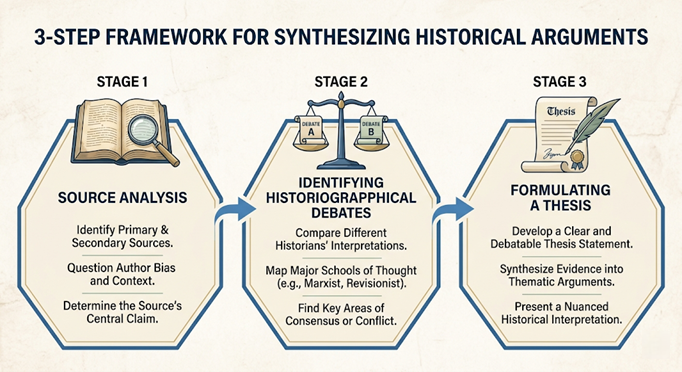
A common mistake in undergraduate writing is relying too heavily on secondary sources (books written by historians) while ignoring primary sources (letters, diaries, laws, or artifacts from the time).
To elevate your analysis:
- Use Primary Sources as Evidence: Let the voices of the past speak for themselves.
- Use Secondary Sources as Context: Use historians to help you understand the broader significance of those primary voices.
- Find the Disconnect: Does a primary source contradict what a modern historian says? That “disconnect” is the perfect place to build your own original argument.
Structuring for Clarity and Flow
A high-ranking academic essay should feel like a guided tour through a complex argument. Each paragraph should follow a logical progression:
- Topic Sentence: Connect the paragraph to your main thesis.
- Evidence: Provide a mix of primary data and secondary interpretations.
- Analysis: Explain how this evidence supports your point.
- Transition: Briefly hint at how this leads to the next idea.
Avoid “data dumping”—the habit of putting a long quote in a paragraph without explaining why it is there. If you don’t explain the quote, the reader (and the marker) will assume you don’t fully understand its significance.
Conclusion: Finding Your Scholarly Voice
The ultimate goal of university history is to find your own voice within the noise of the past. It requires patience, deep reading, and a willingness to accept that history is rarely black and white. By focusing on historiography and moving away from simple summaries, you aren’t just writing an assignment; you are contributing to a long-standing human conversation about who we are and how we got here.
Mastering these skills takes time. Whether you are analyzing the fall of the Roman Empire or the complexities of the Cold War, the key is to stay curious and remain critical of every word you read.
Frequently Asked Questions (FAQ)
1. What is the most common mistake in history essays?
Ans: The most common mistake is being too descriptive. Students often spend 80% of the essay explaining what happened and only 20% analyzing why it happened. Aim for a 40/60 split in favor of analysis.
2. How do I find “historiography” for my topic?
Ans: Look for “Literature Review” sections in academic journals or search for books with titles like “The Historiography of [Your Topic].” You can also look for phrases like “Historians have traditionally argued…” or “A new wave of scholarship suggests…”
3. Can I use “I” in a history essay?
Ans: Generally, it is better to avoid the first person. Instead of saying “I think the treaty was a failure,” say “The evidence suggests the treaty was a failure” or “A critical analysis of the treaty reveals several foundational flaws.”
4. How many sources should I use?
Ans: This depends on your university’s guidelines, but a good rule of thumb for a 1,500-word essay is at least 6–8 high-quality academic sources, including a mix of primary and secondary materials.
5. How do I improve my academic tone?
Ans: Avoid slang, contractions (like “don’t” or “can’t”), and overly emotional language. Focus on being precise, clear, and logical. Use transition words like “consequently,” “furthermore,” and “nevertheless” to connect your ideas.
About The Author
I’m Ethan Martin, an academic content strategist at MyAssignmentHelp, where I focus on bridging the gap between classroom theory and professional writing standards. With years of experience navigating the complexities of university-level research, I specialize in helping students deconstruct difficult prompts and develop clear, authoritative voices in their work.